Sunday, September 7, 2014

Defender of Mitzvot

"Strangely enough the same line of reasoning [of Rabbi Hirsch's, in his criticism of Rambam and his rationalism] resulted in condemnation of both mysticism and rationalism for their non-humanistic ideals. For the rationalist the knowledge of God, and not the practical consequences of the Mitzvot, constitutes the highest desideratum of religious living. … For Hirsch, the Mitzvot must serve the eternal purpose and task of Israel, the mission to humanity. The higher purpose that Maimonides finds in religion is unacceptable to Hirsch...in his zeal for the humanistic conception of Mitzvot."

Rabbi Howard I. Levine "Enduring and Transitory Elements in the Philosophy of Samson Raphael Hirsch" (Tradition 5:2, Spring 1963)
.

Monday, September 1, 2014

Rabbi Shlomo Wolbe on Hirsch, Breuer, and Breuer

"The definition of a gadol be'Yisrael is one who is great in Torah and great in piety, one whose personal views and conduct are based exclusively on those twin pillars. Such a person is acknowledged as a peer by the other great men of his era. Rabbi Samson Raphael Hirsch was revered by the Chassidic leaders of Galicia and by the rabbis of Lithuania. That his views did not accord with theirs was immaterial; his philosophy grew out of his G-d-fearing understanding of Torah, and therefore it was legitimate for him. So it was with Rabbi Salomon Breuer and so it was with Rabbi Joseph Breuer. Their greatness transcended community. They belonged to Klal Yisrael, so they were honored by Klal Yisrael, all of it."

Rabbi Shlomo Wolbe

From Jewish Observer Article

Full article

Wednesday, August 20, 2014

the Seforim blog-An Incident of "Pilegesh B'Givah" in 19th Century Germany

Linked Post:

"AN INCIDENT OF “PILEGESH B’GIVAH” IN 19TH CENTURY GERMANY
by Eli Genauer
I recently purchased an antique Hebrew book for less than the price of a dinner at a moderately priced restaurant. This particular edition is what some would call a “common” — meaning it is the 36th edition (the fourth edition of a revised version) of this book and it was printed in the mid-19th century. Generally, the market does not assign a high price for books like these, but they can be a treasure trove of knowledge and information.
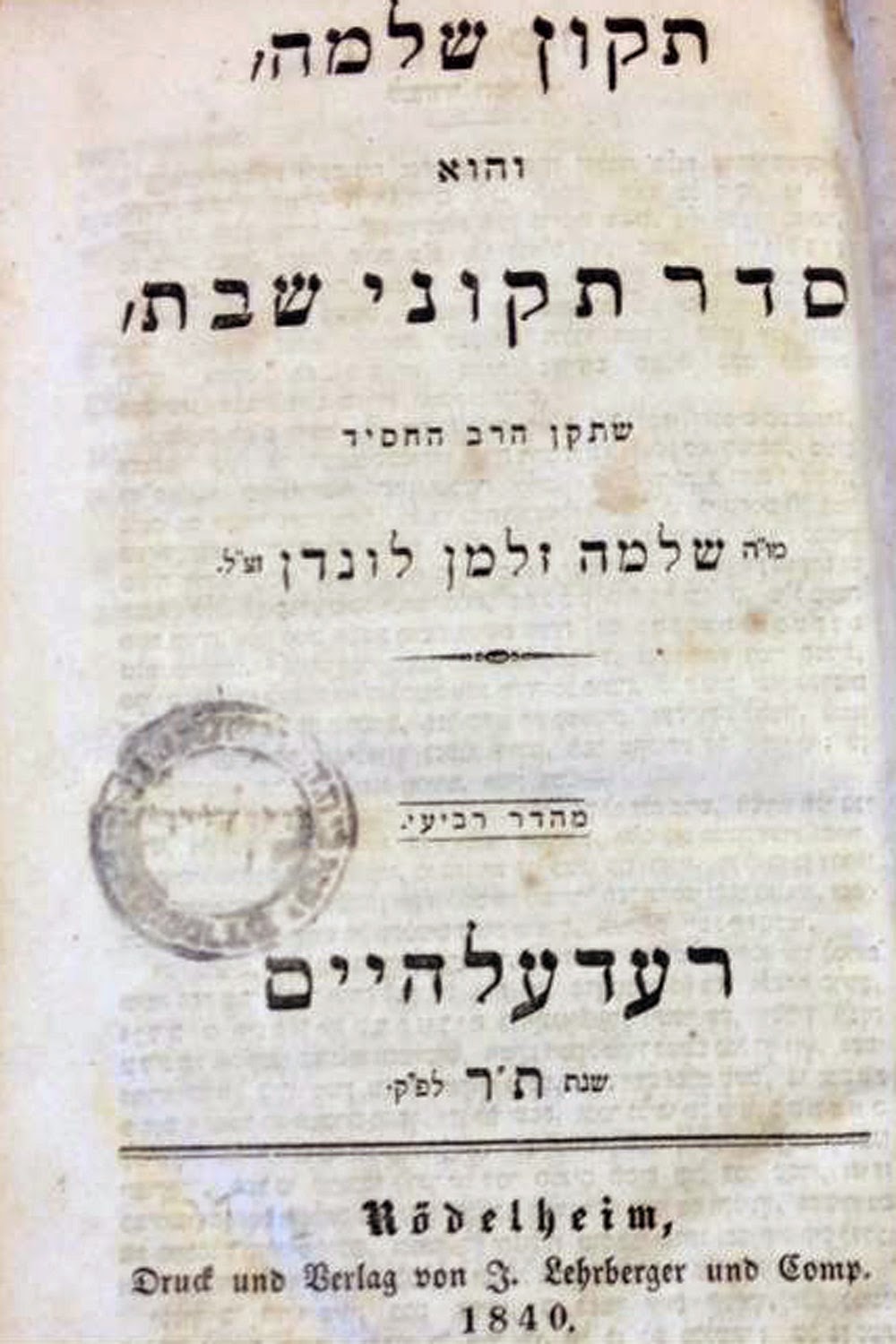
The work is Tikkun Shlomo and is primarily focused on the Shabbos liturgy.  I reproduced the title page:
Many will no doubt recognize the name of the compiler, Shlomo Zalman London (1661-1748) who wrote the book “קהלת שלמה”and that it was reprinted thirty times in the next 200 years.  "
continue:
An Incident of "Pilegesh B'Givah" in 19th Century Germany

Monday, August 18, 2014

Jewish Observer Article on R' Breuer

"He was his era's leading exponent of the Hirschian concept of Torah Im Derech Eretz. Exemplifying and expounding the teachings of Rabbi Hirsch, he gave the broadest possible definition to the term derech eretz. It embraced every facet of a Jew's human existence on earth: his means of livelihood, general decorum, civility, propriety of dress, interaction with his fellow, level of integrity in business and personal relationships, fulfillment of the law of the land, relationship to non-observant Jews, attitude toward purveyors of non-halachic "streams" of Judaism. The definition of derech eretz is as broad and varied as human experience, and wherever it applies, derech eretz must be subservient to Torah."

by Dr. Ernst J. Bodenheimer with Rabbi Nosson Scherman

Read more